Vertigo and Balance Specialists in Lake Charles
It’s likely that you’ve found this page while seeking solutions to dizziness and balance problems. You’ve chosen the right place because Acadian Hearing Services has been the leading balance specialist in Lake Charles, Louisiana for over 30 years.
Through the use of our extensive knowledge and advanced technology, we conduct simple, non-invasive tests. Our audiologists are able to diagnose your condition and offer personalized solutions.
Vertigo and Balance Specialists in Lake Charles
It’s likely that you’ve found this page while seeking solutions to dizziness and balance problems. You’ve chosen the right place because Acadian Hearing Services has been the leading balance specialist in Lake Charles, Louisiana for over 30 years.
Through the use of our extensive knowledge and advanced technology, we conduct simple, non-invasive tests. Our audiologists are able to diagnose your condition and offer personalized solutions.
Vertigo and Balance Specialists in Lake Charles
It’s likely that you’ve found this page while seeking solutions to dizziness and balance problems. You’ve chosen the right place because Acadian Hearing Services has been the leading balance specialist in Lake Charles, Louisiana for over 30 years.
Through the use of our extensive knowledge and advanced technology, we conduct simple, non-invasive tests. Our audiologists are able to diagnose your condition and offer personalized solutions.
The Most Trusted Team of Audiologists in Lake Charles Are Here To Help
If you have a question regarding your hearing care, please reach out to us.
The Most Trusted Team of Audiologists in Lake Charles Are Here To Help
If you have a question regarding your hearing care, please reach out to us.
The Most Trusted Team of Audiologists in Lake Charles Are Here To Help
If you have a question regarding your hearing care, please reach out to us.
Common Balance Disorder Symptoms Section
Symptoms of a balance disorder typically fall into two categories

Motion Intolerance
Dizziness and vertigo sometimes appear after rapid head movements or turning too quickly. These symptoms may be brief or last several hours.
Imbalance or Unsteadiness
This category includes difficulty walking or imbalance associated with any form of upright movement.
Common Balance Disorder Symptoms Section
Symptoms of a balance disorder typically fall into two categories
Motion Intolerance
Dizziness and vertigo sometimes appear after rapid head movements or turning too quickly. These symptoms may be brief or last several hours.
Imbalance or Unsteadiness
This category includes difficulty walking or imbalance associated with any form of upright movement.
Common Balance Disorder Symptoms Section
Symptoms of a balance disorder typically fall into two categories
Motion Intolerance
Dizziness and vertigo sometimes appear after rapid head movements or turning too quickly. These symptoms may be brief or last several hours.
Imbalance or Unsteadiness
This category includes difficulty walking or imbalance associated with any form of upright movement.
Three Common Balance Disorder Causes and Treatments
Balance disorders can result from a variety of causes, including damage to the vestibular system. However, three causes are most common
Benign Paroxysmal Positional Vertigo
BPPV happens when calcium carbonate, or otoconia, breaks off and migrates into one of the semicircular canals. The displaced otoconia send false signals to the brain, disrupting the movement of fluid and causing vertigo.
Mal de Débarquement Syndrome
MdDS or motion sensitivity is a neurological disorder related to your vestibular system. It leaves you feeling as if you’re rocking or swaying after riding in a vehicle or exercising. The brain overreacts to this sensation of motion, leading to dizziness, vertigo, and imbalance.
Vestibular Migraines
Migraines, often associated with an intense headache, are a hereditary neurological disorder. 66% of people with a history of migraines are also prone to dizziness, vertigo, nausea, eye pain, changes to vision, and balance disorders.
Three Common Balance Disorder Causes and Treatments
Balance disorders can result from a variety of causes, including damage to the vestibular system. However, three causes are most common
Benign Paroxysmal Positional Vertigo
BPPV happens when calcium carbonate, or otoconia, breaks off and migrates into one of the semicircular canals. The displaced otoconia send false signals to the brain, disrupting the movement of fluid and causing vertigo.
Mal de Débarquement Syndrome
MdDS or motion sensitivity is a neurological disorder related to your vestibular system. It leaves you feeling as if you’re rocking or swaying after riding in a vehicle or exercising. The brain overreacts to this sensation of motion, leading to dizziness, vertigo, and imbalance.
Vestibular Migraines
Migraines, often associated with an intense headache, are a hereditary neurological disorder. 66% of people with a history of migraines are also prone to dizziness, vertigo, nausea, eye pain, changes to vision, and balance disorders.
Three Common Balance Disorder Causes and Treatments
Balance disorders can result from a variety of causes, including damage to the vestibular system. However, three causes are most common
Benign Paroxysmal Positional Vertigo
BPPV happens when calcium carbonate, or otoconia, breaks off and migrates into one of the semicircular canals. The displaced otoconia send false signals to the brain, disrupting the movement of fluid and causing vertigo.
Mal de Débarquement Syndrome
MdDS or motion sensitivity is a neurological disorder related to your vestibular system. It leaves you feeling as if you’re rocking or swaying after riding in a vehicle or exercising. The brain overreacts to this sensation of motion, leading to dizziness, vertigo, and imbalance.
Vestibular Migraines
Migraines, often associated with an intense headache, are a hereditary neurological disorder. 66% of people with a history of migraines are also prone to dizziness, vertigo, nausea, eye pain, changes to vision, and balance disorders.
Understanding Imbalance: How Are Your Ears Involved?
To maintain balance, your body relies on the coordination of three systems: your visual system, your vestibular system (orientation information), and your proprioceptive system (sensory input from muscles and joints).
A balance disorder or imbalance occurs due to disturbances or malfunctions in any of these systems.
Your ears play a crucial role in balance because the vestibular system is situated in the inner ear. This system detects movement and changes in the positioning of your head. Your inner ear consists of three semicircular canals filled with fluid, which detect upward, downward, and side-to-side movements.
As the fluid moves, it interacts with hair-like cells that send signals to the brain about the body’s positioning or orientation. When the vestibular system becomes damaged, dizziness, vertigo, nausea, and imbalance can cause numerous serious problems.
Vestibular system damage can affect people of any age, resulting from disease, syndromes, toxins, or trauma.

Understanding Imbalance: How Are Your Ears Involved?
To maintain balance, your body relies on the coordination of three systems: your visual system, your vestibular system (orientation information), and your proprioceptive system (sensory input from muscles and joints).
A balance disorder or imbalance occurs due to disturbances or malfunctions in any of these systems.
Your ears play a crucial role in balance because the vestibular system is situated in the inner ear. This system detects movement and changes in the positioning of your head. Your inner ear consists of three semicircular canals filled with fluid, which detect upward, downward, and side-to-side movements.
As the fluid moves, it interacts with hair-like cells that send signals to the brain about the body’s positioning or orientation. When the vestibular system becomes damaged, dizziness, vertigo, nausea, and imbalance can cause numerous serious problems.
Vestibular system damage can affect people of any age, resulting from disease, syndromes, toxins, or trauma.
Understanding Imbalance: How Are Your Ears Involved?
To maintain balance, your body relies on the coordination of three systems: your visual system, your vestibular system (orientation information), and your proprioceptive system (sensory input from muscles and joints).
A balance disorder or imbalance occurs due to disturbances or malfunctions in any of these systems.
Your ears play a crucial role in balance because the vestibular system is situated in the inner ear. This system detects movement and changes in the positioning of your head. Your inner ear consists of three semicircular canals filled with fluid, which detect upward, downward, and side-to-side movements.
As the fluid moves, it interacts with hair-like cells that send signals to the brain about the body’s positioning or orientation. When the vestibular system becomes damaged, dizziness, vertigo, nausea, and imbalance can cause numerous serious problems.
Vestibular system damage can affect people of any age, resulting from disease, syndromes, toxins, or trauma.
What to Expect during Your Balance Assessment
Many patients, who might benefit from an audiology balance test, hesitate because they don’t know what to expect during a balance assessment. To help put your mind at ease, here is what you can expect during your balance assessment
Preparing For Your Assessment
Preparing For Your Assessment
To get the most accurate results, we ask patients to adhere to a few guidelines before their balance assessment.
Refrain from drinking alcohol 24 hours before your balance assessment.
Avoid wearing mascara, eyeliner, or facial lotion when you come to the clinic.
Arrive 15 minutes before your appointment time so you can settle in and be at ease before testing begins.
To get the most accurate results, we ask patients to adhere to a few guidelines before their balance assessment.
Refrain from drinking alcohol 24 hours before your balance assessment.
Avoid wearing mascara, eyeliner, or facial lotion when you come to the clinic.
Arrive 15 minutes before your appointment time so you can settle in and be at ease before testing begins.
Balance And Vestibular Tests
There are several advanced technology tests used during a balance and vertigo assessment. Though your audiologist might not use all of them, here is a brief description of each one and what they are designed to measure.
ENG and VNG Tests
ENG and VNG Tests
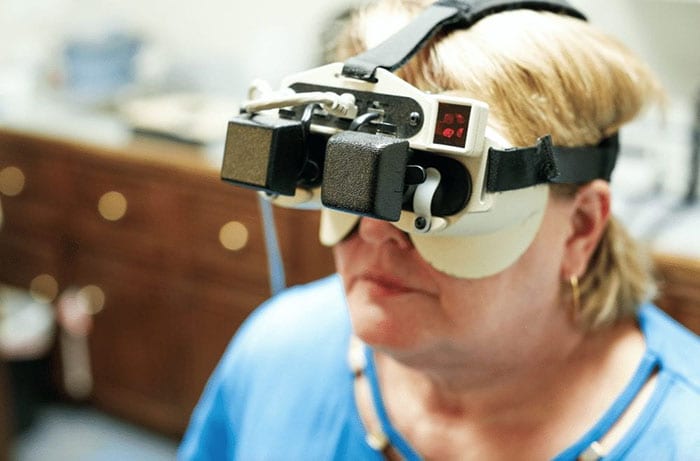
Electronystagmography (ENG) and videonystagmography (VNG) tests record your eye movements, which play a critical role in vestibular function and balance. ENG uses electrodes to record eye movements, while VNG uses small cameras to record eye movements.
Electronystagmography (ENG) and videonystagmography (VNG) tests record your eye movements, which play a critical role in vestibular function and balance. ENG uses electrodes to record eye movements, while VNG uses small cameras to record eye movements.
Computerized Dynamic Posturography
We use computerized dynamic posturography (CDP) testing to assess how well your inner ears, eyes, and the body’s muscles and joints coordinate to help maintain your balance. Standing on a force-sensing surface with the support of a harness, CDP tests which parts of your body’s balance system you rely on most while being subjected to a movable visual surround.
VEMP Test
VEMP Test
Vestibular evoked myogenic potentials (VEMP) tests involve attaching sensor pads to your neck, forehead, and under your eyes in order to measure each minute muscle contraction as you react to sounds. VEMP testing is used to identify vestibular lesions, which might contribute to balance issues.
Vestibular evoked myogenic potentials (VEMP) tests involve attaching sensor pads to your neck, forehead, and under your eyes in order to measure each minute muscle contraction as you react to sounds. VEMP testing is used to identify vestibular lesions, which might contribute to balance issues.
Video Head Impulse Test (vHIT)
Your audiologist might use vHIT to measure your vestibulo-ocular reflex (VOR), which is what helps maintain the focus of your visual field during head rotations. When your VOR is working correctly, head movements are accompanied by equal and opposite eye movements. The absence of these movements or limited reactions help us pinpoint the cause of your imbalance.

Schedule a Balance Assessment
Don’t allow dizziness, vertigo, and imbalance to severely affect your quality of life or that of a loved one. Getting help before the problem worsens is crucial for your overall health and well-being.
Acadian Hearing’s expert assistance is readily available. Fill out and submit the adjacent form to alert one of our specialists. Remember, there’s no such thing as a silly question!
Don't want to wait? Call us at (337) 436-3277.
Schedule a Balance Assessment
Don’t allow dizziness, vertigo, and imbalance to severely affect your quality of life or that of a loved one. Getting help before the problem worsens is crucial for your overall health and well-being.
Acadian Hearing’s expert assistance is readily available. Fill out and submit the adjacent form to alert one of our specialists. Remember, there’s no such thing as a silly question!
Don't want to wait? Call us at (337) 436-3277.
Schedule a Balance Assessment
Don’t allow dizziness, vertigo, and imbalance to severely affect your quality of life or that of a loved one. Getting help before the problem worsens is crucial for your overall health and well-being.
Acadian Hearing’s expert assistance is readily available. Fill out and submit the adjacent form to alert one of our specialists. Remember, there’s no such thing as a silly question!
Don't want to wait? Call us at (337) 436-3277.
Local Hearing Care Experts Answer Your Questions
Expert hearing care tailored to your unique needs - because better hearing starts here

Luther’s Journey to Better Hearing with Acadian Hearing Services
Discover how Luther found clear hearing and expert care at Acadian Hearing Services in Lake Charles. Read his story and see why he rates us 10/10.

Your Hearing Health Is Key to Protecting Your Brain
Learn how treating hearing loss can protect your cognitive health. Discover the WHO's new guidelines with our Lake Charles audiologists. Call today.

"Run, Don’t Walk!": Why Maria Has Trusted Acadian Hearing Services for Over Three Decades
Hearing care should never feel intimidating or rushed.
Local Hearing Care Experts Answer Your Questions
Expert hearing care tailored to your unique needs - because better hearing starts here
Luther’s Journey to Better Hearing with Acadian Hearing Services
Discover how Luther found clear hearing and expert care at Acadian Hearing Services in Lake Charles. Read his story and see why he rates us 10/10.
Your Hearing Health Is Key to Protecting Your Brain
Learn how treating hearing loss can protect your cognitive health. Discover the WHO's new guidelines with our Lake Charles audiologists. Call today.
"Run, Don’t Walk!": Why Maria Has Trusted Acadian Hearing Services for Over Three Decades
Hearing care should never feel intimidating or rushed.
Local Hearing Care Experts Answer Your Questions
Expert hearing care tailored to your unique needs - because better hearing starts here
Luther’s Journey to Better Hearing with Acadian Hearing Services
Discover how Luther found clear hearing and expert care at Acadian Hearing Services in Lake Charles. Read his story and see why he rates us 10/10.
Your Hearing Health Is Key to Protecting Your Brain
Learn how treating hearing loss can protect your cognitive health. Discover the WHO's new guidelines with our Lake Charles audiologists. Call today.
"Run, Don’t Walk!": Why Maria Has Trusted Acadian Hearing Services for Over Three Decades
Hearing care should never feel intimidating or rushed.