Infant Hearing Tests For Early Detection of Hearing Challenges
Should your infant not pass the initial newborn screening, your hospital will schedule a diagnostic ABR/DPOAE examination with an Audiologist from Acadian Hearing and Speech Services after your baby is released.
To achieve the best possible results, intervention for babies with hearing loss needs to begin before your child is six months old.

Infant Hearing Tests For Early Detection of Hearing Challenges
Should your infant not pass the initial newborn screening, your hospital will schedule a diagnostic ABR/DPOAE examination with an Audiologist from Acadian Hearing and Speech Services after your baby is released.
To achieve the best possible results, intervention for babies with hearing loss needs to begin before your child is six months old.
Infant Hearing Tests For Early Detection of Hearing Challenges
Should your infant not pass the initial newborn screening, your hospital will schedule a diagnostic ABR/DPOAE examination with an Audiologist from Acadian Hearing and Speech Services after your baby is released.
To achieve the best possible results, intervention for babies with hearing loss needs to begin before your child is six months old.


Important Facts About Infant Hearing Loss
Early detection and treatment of infant hearing loss are crucial for healthy speech, language, and cognitive development
Congenital Cytomegalovirus (CMV) Infection Can Cause Infant Hearing Loss
Congenital Cytomegalovirus (CMV) Infection Can Cause Infant Hearing Loss
Infections, Environmental Causes, And Birth Complications Affect Infant Hearing Loss
Infections, Environmental Causes, And Birth Complications Affect Infant Hearing Loss
Genetics Is A Major Factor In Infant Hearing Loss
Genetics Is A Major Factor In Infant Hearing Loss
Several Disabilities Co-occur In Those With Infant Hearing Loss
Several Disabilities Co-occur In Those With Infant Hearing Loss
Low Birth Weights Are Commonly Associated With Infant Hearing Loss
Low Birth Weights Are Commonly Associated With Infant Hearing Loss
What To Expect During ABR/DPOAE Testing
An exam so easy your baby doesn’t even have to be awake to take it? It might seem too good to be true, but it really is. In fact, the two tests used for infant hearing evaluations take just a few minutes, are pain-free, and are done while your infant is asleep or eating.
Preparing For Testing
For an infant diagnostic hearing exam with Acadian Hearing and Speech Services, your baby should be tired and hungry so that the parent can feed the infant during the exam. This helps make things go a lot smoother. Please no hair gels, lotions, or earrings.
Distortion Product Otoacoustic Emissions (DPOAE)
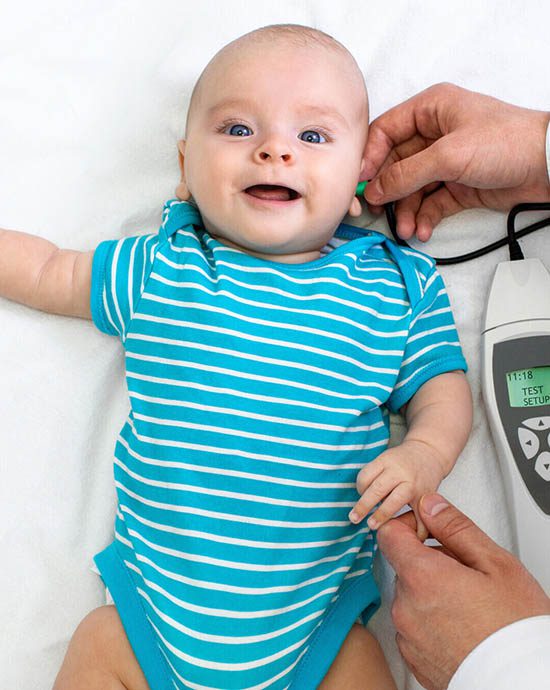
Your baby’s audiologist will insert a tiny probe that emits a series of sounds just at the entrance to your baby’s ear canal. DPOAEs are distorted sounds generated by the cochlea’s outer hair cells in response to two tones that are close in frequency. The presence of a DPOAE response is an indication that the cochlear amplifier is functioning properly.
Auditory Brainstem Response (ABR)
Imagine a pair of tiny headphones that will fit into your baby’s ear canals. That’s what your audiologist will use, along with an array of electrodes placed on his/her scalp. As your baby listens to the transmitted sounds, the ABR system will measure auditory neurosychrony. If the auditory neurosychrony is abnormal, this would be an indicator of hearing problems.
What To Expect During ABR/DPOAE Testing
An exam so easy your baby doesn’t even have to be awake to take it? It might seem too good to be true, but it really is. In fact, the two tests used for infant hearing evaluations take just a few minutes, are pain-free, and are done while your infant is asleep or eating.
Preparing For Testing
For an infant diagnostic hearing exam with Acadian Hearing and Speech Services, your baby should be tired and hungry so that the parent can feed the infant during the exam. This helps make things go a lot smoother. Please no hair gels, lotions, or earrings.
Distortion Product Otoacoustic Emissions (DPOAE)
Your baby’s audiologist will insert a tiny probe that emits a series of sounds just at the entrance to your baby’s ear canal. DPOAEs are distorted sounds generated by the cochlea’s outer hair cells in response to two tones that are close in frequency. The presence of a DPOAE response is an indication that the cochlear amplifier is functioning properly.
Auditory Brainstem Response (ABR)
Imagine a pair of tiny headphones that will fit into your baby’s ear canals. That’s what your audiologist will use, along with an array of electrodes placed on his/her scalp. As your baby listens to the transmitted sounds, the ABR system will measure auditory neurosychrony. If the auditory neurosychrony is abnormal, this would be an indicator of hearing problems.
What To Expect During ABR/DPOAE Testing
An exam so easy your baby doesn’t even have to be awake to take it? It might seem too good to be true, but it really is. In fact, the two tests used for infant hearing evaluations take just a few minutes, are pain-free, and are done while your infant is asleep or eating.
Preparing For Testing
For an infant diagnostic hearing exam with Acadian Hearing and Speech Services, your baby should be tired and hungry so that the parent can feed the infant during the exam. This helps make things go a lot smoother. Please no hair gels, lotions, or earrings.
Distortion Product Otoacoustic Emissions (DPOAE)
Your baby’s audiologist will insert a tiny probe that emits a series of sounds just at the entrance to your baby’s ear canal. DPOAEs are distorted sounds generated by the cochlea’s outer hair cells in response to two tones that are close in frequency. The presence of a DPOAE response is an indication that the cochlear amplifier is functioning properly.
Auditory Brainstem Response (ABR)
Imagine a pair of tiny headphones that will fit into your baby’s ear canals. That’s what your audiologist will use, along with an array of electrodes placed on his/her scalp. As your baby listens to the transmitted sounds, the ABR system will measure auditory neurosychrony. If the auditory neurosychrony is abnormal, this would be an indicator of hearing problems.
What Do The Test Results Mean?
About 90% of newborn babies who don’t pass their first screening pass a subsequent hearing test. Babies can fail initial screenings due to temporary conditions such as too much wax, vernix, or fluid in the ear.
There are essentially three result scenarios after an infant hearing test:
1. Testing determines that your infant does have some hearing loss in one or both ears. It's critical for treatment to start within the first six months of life in order to provide opportunity for learning how to speak & acquire language skills.
2. While your baby may pass the newborn hearing screening, it does not rule out the possibility that he/she could experience hearing loss later on. If your child passes, your audiologist will still want you to monitor speech/language progress in order to catch the problem as early as possible.
3. A third scenario involves passing the initial screening, but with some indicators that your baby might develop late-onset hearing loss due to genetic disposition, illnesses, secondhand smoke, or NICU treatments.
What Do The Test Results Mean?
About 90% of newborn babies who don’t pass their first screening pass a subsequent hearing test. Babies can fail initial screenings due to temporary conditions such as too much wax, vernix, or fluid in the ear.
There are essentially three result scenarios after an infant hearing test:
1. Testing determines that your infant does have some hearing loss in one or both ears. It's critical for treatment to start within the first six months of life in order to provide opportunity for learning how to speak & acquire language skills.
2. While your baby may pass the newborn hearing screening, it does not rule out the possibility that he/she could experience hearing loss later on. If your child passes, your audiologist will still want you to monitor speech/language progress in order to catch the problem as early as possible.
3. A third scenario involves passing the initial screening, but with some indicators that your baby might develop late-onset hearing loss due to genetic disposition, illnesses, secondhand smoke, or NICU treatments.
What Do The Test Results Mean?
About 90% of newborn babies who don’t pass their first screening pass a subsequent hearing test. Babies can fail initial screenings due to temporary conditions such as too much wax, vernix, or fluid in the ear.
There are essentially three result scenarios after an infant hearing test:
1. Testing determines that your infant does have some hearing loss in one or both ears. It's critical for treatment to start within the first six months of life in order to provide opportunity for learning how to speak & acquire language skills.
2. While your baby may pass the newborn hearing screening, it does not rule out the possibility that he/she could experience hearing loss later on. If your child passes, your audiologist will still want you to monitor speech/language progress in order to catch the problem as early as possible.
3. A third scenario involves passing the initial screening, but with some indicators that your baby might develop late-onset hearing loss due to genetic disposition, illnesses, secondhand smoke, or NICU treatments.

Treatment Solutions For Hearing Loss In Babies
Acadian Hearing and Speech Services provides solutions and ongoing guidance with early intervention from the State parent/pupil teams, speech/ language intervention, and hearing aid options.
We’ll form an early intervention plan within the first six months of age that includes your baby’s pediatrician, audiologist, otolaryngologist, and more. This team of specialists will help guide your decisions regarding which treatments or devices will provide the best outcomes for your baby
Interventions may include:
Meeting with a professional who is trained to work with children who have hearing loss as well as their families.
Working with a professional who can help a family and child learn to communicate.
Fitting a baby with a hearing device, such as a hearing aid or cochlear implant.
Joining family support groups.
Other resources available to children with hearing loss and their families.
Treatment Solutions For Hearing Loss In Babies
Acadian Hearing and Speech Services provides solutions and ongoing guidance with early intervention from the State parent/pupil teams, speech/ language intervention, and hearing aid options.
We’ll form an early intervention plan within the first six months of age that includes your baby’s pediatrician, audiologist, otolaryngologist, and more. This team of specialists will help guide your decisions regarding which treatments or devices will provide the best outcomes for your baby
Interventions may include:
Meeting with a professional who is trained to work with children who have hearing loss as well as their families.
Working with a professional who can help a family and child learn to communicate.
Fitting a baby with a hearing device, such as a hearing aid or cochlear implant.
Joining family support groups.
Other resources available to children with hearing loss and their families.
Treatment Solutions For Hearing Loss In Babies
Acadian Hearing and Speech Services provides solutions and ongoing guidance with early intervention from the State parent/pupil teams, speech/ language intervention, and hearing aid options.
We’ll form an early intervention plan within the first six months of age that includes your baby’s pediatrician, audiologist, otolaryngologist, and more. This team of specialists will help guide your decisions regarding which treatments or devices will provide the best outcomes for your baby
Interventions may include:
Meeting with a professional who is trained to work with children who have hearing loss as well as their families.
Working with a professional who can help a family and child learn to communicate.
Fitting a baby with a hearing device, such as a hearing aid or cochlear implant.
Joining family support groups.
Other resources available to children with hearing loss and their families.
Frequently Asked Questions About Children's Hearing Loss
If you have any other questions, please email us.
Does My Child Need To Have Regular Hearing Assessments?
How Can I Help Protect My Child’s Hearing?
How Do I Address My Child’s Hearing Challenges With Caregivers And Teachers?
How Can I Help My Child Understand The Hearing Challenges He/She Is Facing?
Schedule An Infant Hearing Test
If your child did not receive a newborn hearing screening (mandated by the State of Louisiana), was flagged for a follow-up hearing assessment, or is struggling with speech/communication, complete and submit the adjacent form to schedule an infant hearing test.
Don't want to wait? Call us at (337) 436-3277.
Schedule An Infant Hearing Test
If your child did not receive a newborn hearing screening (mandated by the State of Louisiana), was flagged for a follow-up hearing assessment, or is struggling with speech/communication, complete and submit the adjacent form to schedule an infant hearing test.
Don't want to wait? Call us at (337) 436-3277.
Schedule An Infant Hearing Test
If your child did not receive a newborn hearing screening (mandated by the State of Louisiana), was flagged for a follow-up hearing assessment, or is struggling with speech/communication, complete and submit the adjacent form to schedule an infant hearing test.
Don't want to wait? Call us at (337) 436-3277.
Local Hearing Care Experts Answer Your Questions
Expert hearing care tailored to your unique needs - because better hearing starts here

Your Hearing Health Is Key to Protecting Your Brain
Learn how treating hearing loss can protect your cognitive health. Discover the WHO's new guidelines with our Lake Charles audiologists. Call today.

"Run, Don’t Walk!": Why Maria Has Trusted Acadian Hearing Services for Over Three Decades
Hearing care should never feel intimidating or rushed.

The Subtle Fade: Recognizing the Signs of Hearing Loss
Taking the first step toward better hearing changes everything.
Local Hearing Care Experts Answer Your Questions
Expert hearing care tailored to your unique needs - because better hearing starts here
Your Hearing Health Is Key to Protecting Your Brain
Learn how treating hearing loss can protect your cognitive health. Discover the WHO's new guidelines with our Lake Charles audiologists. Call today.
"Run, Don’t Walk!": Why Maria Has Trusted Acadian Hearing Services for Over Three Decades
Hearing care should never feel intimidating or rushed.
The Subtle Fade: Recognizing the Signs of Hearing Loss
Taking the first step toward better hearing changes everything.
Local Hearing Care Experts Answer Your Questions
Expert hearing care tailored to your unique needs - because better hearing starts here
Your Hearing Health Is Key to Protecting Your Brain
Learn how treating hearing loss can protect your cognitive health. Discover the WHO's new guidelines with our Lake Charles audiologists. Call today.
"Run, Don’t Walk!": Why Maria Has Trusted Acadian Hearing Services for Over Three Decades
Hearing care should never feel intimidating or rushed.
The Subtle Fade: Recognizing the Signs of Hearing Loss
Taking the first step toward better hearing changes everything.